
How to Search for a Warrant in Monroe County
The public online starting point is Indiana MyCase. It searches eligible court cases from the Odyssey system, including the nine Monroe Circuit Court divisions coded 53C01 through 53C09. It is not a live law-enforcement warrant database. A docket can supply the case context, court division, and event history needed for the next call, but it cannot certify that a warrant remains active.
Gather a case or citation number if one is known. Otherwise use the full legal name, a middle name, and date of birth to narrow a party search. Search only for a lawful personal need, such as checking your own case or helping a relative understand a notice. If a warrant may be active, speak with counsel before arranging a surrender or taking any step that could affect the case.
- Search MyCase by case number, citation number, cross-reference, party, or attorney.
- Limit the court to Monroe and compare the docket details carefully.
- Ask the Monroe County Clerk to verify the available public court record.
- Call the Sheriff's Warrant Division at 812-349-2778 for operational status.
- Use a narrow APRA request when a specific Sheriff record is needed, and use PACER for a federal matter.
Monroe County MyCase Limits
MyCase is valuable because it gathers public Indiana court information in one place. Its own help material also says the online information is not the official court record and may contain errors or omissions. Older documents may not be online. A newly filed event may take time to appear, while a later recall, service return, or correction may change what an earlier docket line seems to mean.
The MyCase help page explains those limits. No result is not proof that no Monroe County warrant exists. Likewise, seeing the word “warrant” in an event description does not prove it is active today. The Clerk can address the public court file; the Warrant Division is the better channel for present service or enforcement status.
The official search interface can be reviewed at its public MyCase source.
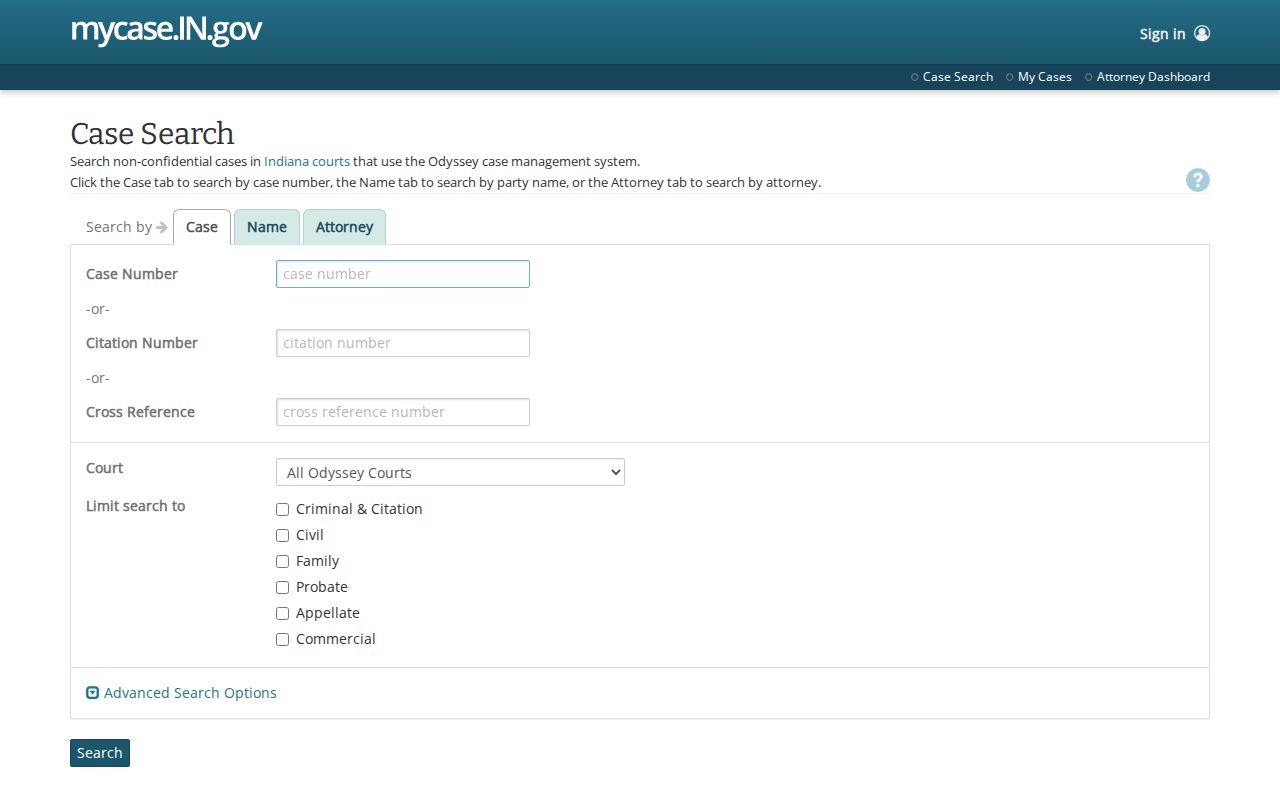
The screen shows case-search choices rather than a Monroe County active-warrant roster.
Monroe County Warrant Search Fields
MyCase offers three search paths. A case search accepts a case number, citation number, or cross-reference. A party search begins with a last name and may be narrowed by first and middle names, date of birth, business name, sounds-like matching, and court. Attorney search accepts a name or bar number. The official search tips explain that broad searches can reach a 1,000-result limit.
| Field Label | Type | Required | Notes |
|---|---|---|---|
| Last Name | Text | Party search | A trailing wildcard may help, but the name must be specific enough. |
| First or Middle Name | Text | No | Narrows common-name results. |
| Date of Birth | Date | No | Narrows the query but is not displayed in public results. |
| Case or Citation Number | Text | Case search | Best when copied from an official notice. |
| Court | Selection | No | Choose Monroe Circuit Court where appropriate. |
The search-tips view illustrates the filters and their use without exposing a person's result.
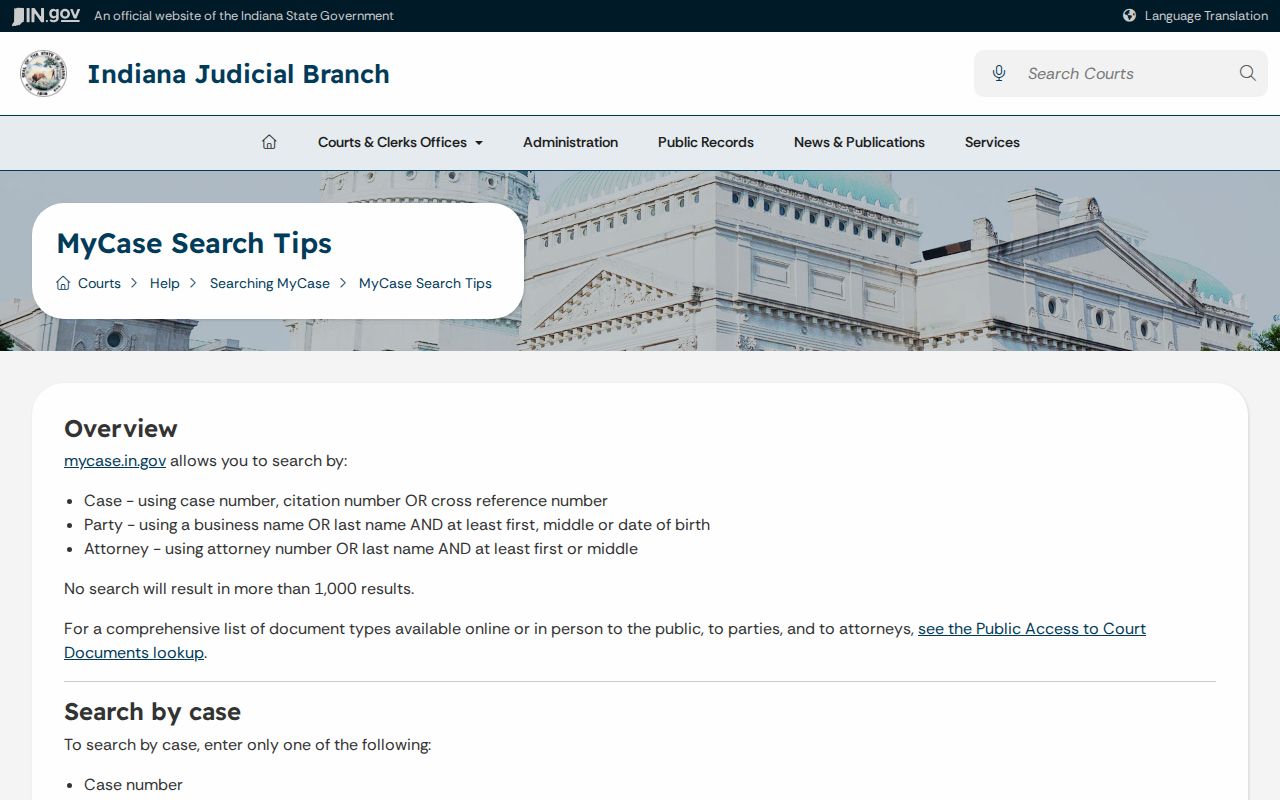
These fields locate public cases; none is a dedicated warrant-number lookup.
Match Monroe Warrant Names Carefully
A name match is only a lead. Common names, changed names, spelling differences, and incomplete middle names can point to the wrong case. Date of birth is useful as an input, but MyCase does not display it as a public result field. Compare the court, case type, filing date, and citation or case number instead of relying on a name alone.
Use sounds-like matching or a trailing wildcard only when needed. Then narrow the result to Monroe County. Do not gather unrelated files returned by a broad search. If the details conflict, stop and ask the Clerk which public record belongs to the known case number. That protects against a false match and produces a better question for the Warrant Division.
What a Monroe County Warrant Search Returns
A MyCase result can show a case number, caption, court, case type, filing date, parties, charges, docket events, and selected public documents. It may include a warrant-related entry, yet it may not expose the warrant itself or its current execution status. Indiana law supplies the model for the written instrument, while the online docket supplies only what public access rules allow.
| Case Number | A court identifier such as 53C01-YY-…, not proof of current status. |
|---|---|
| Charge or Case Type | The allegation or category linked to the public file. |
| Issuing Court | The Monroe Circuit Court division responsible for the matter. |
| Bond Direction | Displayed only when the public record includes it; confirm current terms. |
| Docket Event | May describe issue, service, return, recall, or another court action. |
Read later events before drawing a conclusion. A court order, not a search-site label, controls recall or quash.
Verify Conflicting Monroe Warrant Results
When an online entry looks old, incomplete, or inconsistent, write down the case number, division, event label, and date. Call the Clerk at 812-349-2614 and ask whether the public docket is complete and which office controls the next step. Clerk staff maintain the record, but they do not serve warrants or promise that a judge will recall one.
For present operational status, call the Monroe County Sheriff's Warrant Division at 812-349-2778. Its page also lists fax 812-349-2828 and investigations@co.monroe.in.us. Ask what identification or case details are required. A person who may need to surrender should confirm the place and time with counsel or the responsible agency.
Where Monroe County Warrants Are Checked
Monroe Circuit Court issues local judicial process through nine unified divisions. The Monroe County Clerk keeps the public court file. The Sheriff's Warrant Division handles operational questions and service. Bloomington, Ellettsville, and Stinesville have local police functions, but the official Odyssey list shows no separate municipal warrant court or public city warrant database.
Indiana offers no public statewide arrest- or bench-warrant search. MyCase is statewide in reach, but it remains a public court-case portal. Federal matters also sit outside Monroe Circuit Court; public federal docket research starts with PACER and the Southern District of Indiana. These boundaries explain why a responsible Monroe County warrant search uses more than one official source.
The Monroe Circuit Court source shows the local court fallback.
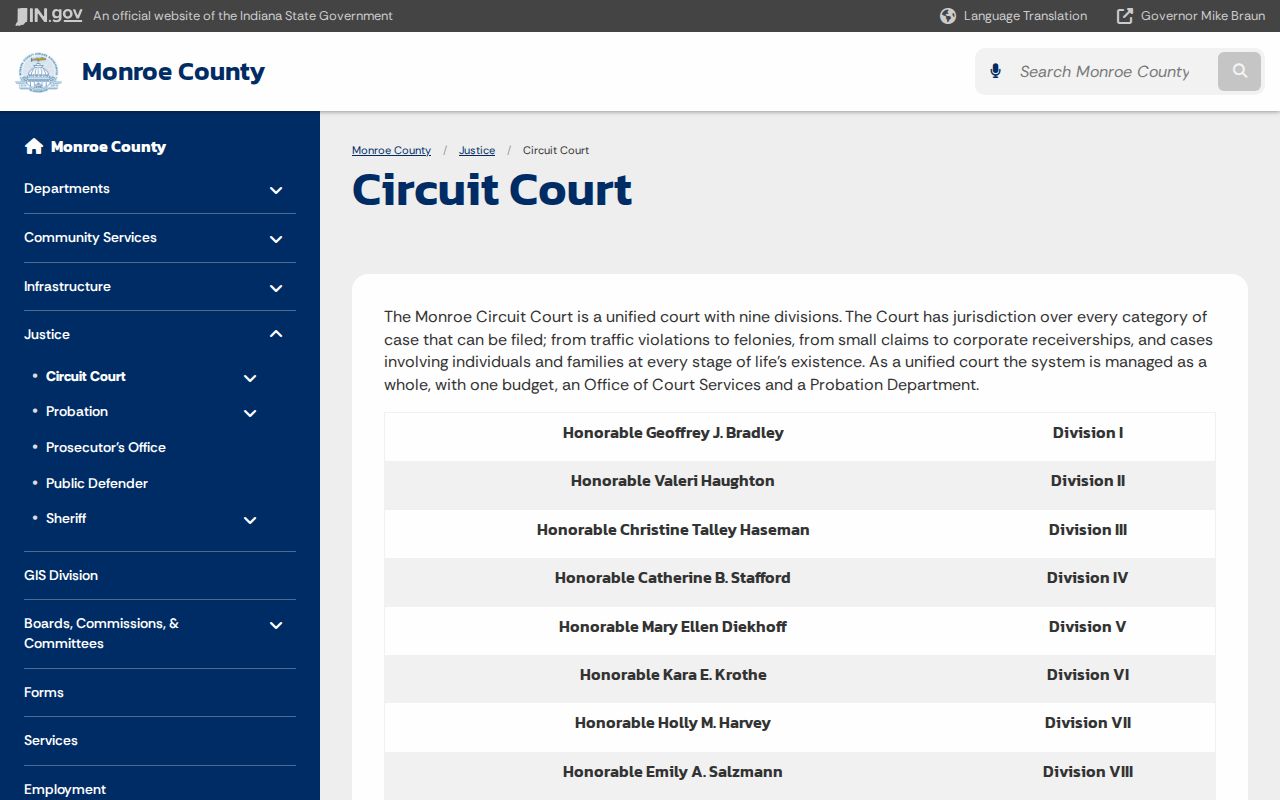
The court page routes a searcher toward the right division instead of claiming to be a live warrant list.
No Monroe County Public Roster
The official Sheriff pages reviewed do not publish a public name-search box, active-warrant table, mugshot list, or online clearing form. That negative finding matters. It means the Warrant Division contact page should not be recast as an online warrant-search portal, and a commercial roster should not be used to fill the gap.
The official page presents contact routes for current questions.
The image confirms a contact channel, not a list of people. Ask for status tied to a known personal matter and do not treat silence online as clearance.
Access to Restricted Monroe Warrants
The Indiana Access to Public Records Act, IC 5-14-3, provides a public-record framework, while the Indiana Rules on Access to Court Records govern court files. Public access has firm limits. Sealed, expunged, juvenile, mental-health, protection-order, and other confidential material may be hidden or restricted. Sheriff investigatory records may also be withheld under an applicable APRA exemption.
Key Rules:
Sealed and expunged matters are not open merely because a name is known.
Juvenile and mental-health records are excluded from the Clerk's public online route.
Investigatory limits and docket delay mean absence from search results is not proof that no warrant exists.
A narrow record request should identify a case, citation, date span, policy, or document type. The Sheriff form permits email, fax, mail, or in-person submission and describes a seven-day receipt response, not guaranteed production in seven days. The Clerk has a separate record-request route. Use the custodian that holds the requested record.
Monroe Warrant Requests by Record
A formal request works best when it asks for a specific institutional record, not a blanket list of people. Send a court docket or document request through the Clerk records route. Send a request for a Sheriff-held public record through the agency's APRA form and records contact. Custody questions belong with the Correctional Center, while BMV status belongs with the BMV.
Include a known case or citation number, court division, document type, and date span. Ask for an electronic copy when that meets the need. The Sheriff may control the time and manner of inspection and may withhold confidential or investigatory material. If access is denied, the form says the agency should identify the exemption. “No responsive record” does not certify that no Monroe County warrant exists.